

Designing Teams That Actually Work: How PI Team Design Turns Insight into Action
If you’ve ever taken the PI Behavioral Assessment, you probably remember the moment.
You opened the report.
You nodded along.
You maybe chuckled a little.
You think, “Wow… have you been following me?”
No hidden cameras. No cubicle surveillance. Just really good behavioral science.
I often ask people a simple follow-up question after they read their PI report: If I handed you a blank piece of paper, could you have written this about yourself? Almost everyone says no. Not because they don’t know themselves, but because the PI Behavioral Assessment surfaces things they feel but haven’t been able to put into words.
That’s exactly what PI Team Design does for teams.
What Is PI Team Design
(And How It Works)
PI Team Design isn’t a personality exercise or a “fun” team activity that disappears by next Tuesday. It’s a structured way of designing teams intentionally, using real behavioral data.
Most leaders already have a surface-level read on their group. You know who talks the most. Who loves details. Who prefers to observe quietly before jumping in. But Team Design goes several layers deeper. It helps you understand what’s actually happening beneath the behaviors — the natural strengths your team relies on, the obstacles that quietly get in the way, and the patterns that shape how people collaborate, make decisions, and move work forward.
In other words, it moves you from casual team building to intentional team strategy. The process itself is refreshingly practical.
Here’s how it works:
Step 1: Load Your Team
Start by bringing your team’s PI Behavioral Assessment data into the tool. You’ll see each individual’s strengths, needs, and behavioral drives side by side.
This alone is a collaboration win. Most teams have never looked at their collective makeup this clearly.
Step 2: Identify Your Team Type
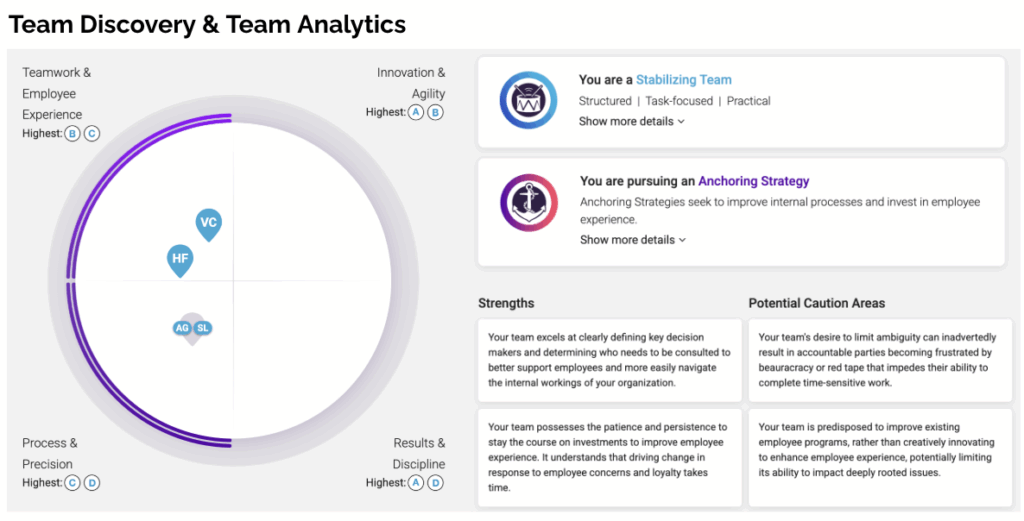
Next, you’ll uncover your Team Type—how your team behaves together. This is where things get interesting. You’ll explore how individual strengths pair up, amplify each other, or occasionally trip each other up.
Step 3: Review Cautions (a.k.a. “What Keeps Biting Us”)
This is the most valuable—and most honest—part of Team Design.
You’ll review common team cautions and ask:
- What has gotten in our way in the past?
- Where do we consistently stall, rush, or overcomplicate things?
For established teams, this creates powerful “ohhh… that’s why” moments. For new teams, it creates awareness before problems show up.
Step 4: Build an Action Plan
Insight without action is just trivia.
Team Design pushes teams to define clear adjustments: how they’ll communicate, make decisions, assign roles, and move work forward, on purpose.

Understanding Team Types
(Yes, Teams Have Personalities Too)
Just like PI has 17 reference profiles for individuals, PI Team Design identifies 9 Team Types. A Team Type is a scientifically validated description of a team’s collective behavior, powered by aggregated data. It doesn’t judge whether a team is good or bad. It shows how the team naturally operates and what that means in the real world.
Let’s look at three common examples.
A Pathfinding Team
Fast-paced. Goal-oriented. Competitive. Relentless.
With a Pathfinding team, there’s no shortage of ideas or energy. Healthy conflict is common, and innovation comes naturally. The challenge? Alignment and follow-through. With so many confident starters, people leave meetings ready to act — just not always in the same direction. Individual goals move quickly. Team goals lag behind. Pathfinding teams don’t need agreement to get started, but they do need cohesion to win together.
Questions Pathfinding Teams Should Ask Themselves:
- How are we defining “winning” as a team, not just as individuals?
- Where do we need clearer ownership to avoid parallel (and conflicting) work?
- What systems will force us to pause, align, and follow through?
A Stabilizing Team
Structured. Organized. Practical. Detail-driven.
Stabilizing teams are the masters of quality. They value process, accuracy, and consistency. If you want something done right, this is your crew. The work is excellent. The timeline, less so. When everyone’s natural inclination is to get things to 100% before testing, momentum can stall. Progress slows not because the team lacks talent, but because perfection quietly becomes the bottleneck.
Questions Stabilizing Teams Should Ask Themselves:
- Where is “perfect” slowing progress more than it’s protecting quality?
- What guardrails would help us move forward with confidence instead of caution?
- Who on our team will keep us accountable to the timeline?
An Adapting Team
Flexible. Versatile. Well-rounded.
On paper, Adapting Teams look like they can do anything. And they can. But without clear roles and guardrails, they can also end up doing very little. When everyone has overlapping strengths, ownership gets fuzzy. The potential is enormous, but only if the team intentionally aligns people to the right work.
Questions Adapting Teams should Ask Themselves:
- What is the consensus on how we will communicate as a team?
- How do we ensure tasks are well-defined and assigned to individuals motivated by that type of work?
- Where might differing workstyles cause conflict and how might we mitigate that?
Team Awareness Is the Real Advantage
This is where team awareness becomes the real edge.
Leaders often ask whether their PI profile is “good for leadership.” That’s the wrong question. PI doesn’t tell you if you’ll be a good leader. It tells you how you lead. Team Design works the same way.
Your Team Type doesn’t tell you whether you have a “good” or “bad” team. It tells you how your team will:
- Communicate
- Make decisions
- Handle conflict
- Respond to change
- Collaborate under pressure
The goal isn’t a perfect team.
It’s an aware team.
One that understands its natural strengths, recognizes its caution areas, and makes intentional accommodations to optimize how work gets done.
The Power Move: Finding (or Developing) Balancers
Many team gaps can be closed with better self-awareness, clearer communication, and a stronger commitment to leveraging strengths. Sometimes, though, teams benefit from identifying balancers — people whose natural behaviors offset the dominant tendencies of the group.
A fast-moving Pathfinding team may need someone who naturally creates structure and follow-through. A cautious Stabilizing team may benefit from someone who’s comfortable testing, iterating, and taking smart risks.
You may already have a balancer on your team. If you do, recognize and protect that role. Consider how you can continue to leverage that person’s strengths without burning them out. If you don’t have a balancer, look beyond your immediate group. It might be a development opportunity for a high-potential leader elsewhere in the organization.
That’s not just team design. That’s team strategy.
Final Thought: Design Beats Guesswork
Great collaboration doesn’t happen by accident. Neither does high-performing teamwork.
PI Team Design helps leaders move beyond surface-level team building activities and into the real work of designing teams intentionally, optimizing teams for performance, and building a collaboration strategy grounded in data—not vibes.
If you’re ready to stop guessing and start designing, we should talk.
Schedule a conversation with MindWire
and see how PI Team Design can turn insight into action for your team.